You Have Been Here Before
A genealogy for the spiritual-but-not-religious: where the ideas you found for yourself actually come from, who wrote them down first — and what happened when their pedigree was put to the test.
"Truth is a pathless land."
— Jiddu Krishnamurti, dissolving the Order of the Star, 1929. Even the refusal of paths has a birthday, and an address.Abstract — and a promise
This paper is addressed to the reader who would never call themselves a Theosophist, a New Ager, or indeed anything at all: who holds, as personal discoveries or as things "all traditions really point to," some family of ideas — Jesus as one awakened teacher among many, the kingdom of God as a state of consciousness, "I AM" as the universal awareness we all share, reincarnation edited out of Christianity by councils, the Egyptian roots of the gospel story. The paper's claim is historical, not spiritual: these ideas are not a timeless current you tapped into, nor conclusions your experience produced unaided. Each one has a documented author, a publication date, and a transmission path — most of them running through a single, surprisingly recent, and thoroughly investigated lineage. We trace the genealogy item by item, close the standard escape routes ("I worked it out myself," "it's from my own experience," "the parallels are obvious," "the Church suppressed it"), and summarize what happened on the several occasions the lineage's claims to antiquity were formally examined. The promise: nothing here mocks the hunger, and nothing here requires you to adopt any religion. It only asks you to know where your beliefs were manufactured — because you were told they were found, and the difference matters. The feeling of uniqueness is, as we will see, itself part of the product.
Part I · The inventory
An inventory of things you may believe
Start with an honest stocktake. Read the list below slowly, and mark — mentally is fine — the items that feel less like opinions you adopted and more like things you saw: conclusions that arrived on their own, or that "all the traditions, underneath, are really saying."
Field inventory · tick what feels like yours
- All religions are different paths up the same mountain; the differences are packaging.
- Jesus was an enlightened master — a Buddha-figure — teaching elevated consciousness; the Church later turned him into something else.
- "The kingdom of God is within you" means the kingdom is a state of consciousness, here and now.
- "Christ" is a state — Christ-consciousness — which Jesus attained and anyone can attain.
- God's name "I AM" reveals that God is consciousness itself — the awareness in you reading this line.
- You are God; the universe is consciousness experiencing itself.
- Jesus taught reincarnation; the Church removed it at a council in the sixth century.
- There were other gospels — earlier, purer — that the Church suppressed.
- Jesus spent his lost years in India or Tibet.
- The Jesus story recycles Egyptian myth — Horus: virgin birth, December 25th, twelve followers, resurrection.
- "As above, so below"; everything is energy and vibration; like attracts like.
- "Sin" is really ignorance; there is nothing to be forgiven, only something to wake up from.
- Ancient Egypt and the mystery schools held an advanced spiritual science we've lost.
- You don't like labels; your path is your own; truth can't be organized.
Here is the claim of this paper, stated without decoration: every item on that list has a birth certificate. Not a mystical origin in deep time — a publication date, an author, in most cases a city, and in a remarkable number of cases the same small circle of authors working between roughly 1875 and 1948. The sensation of having arrived at these ideas independently is real; the independence is not. They are in the cultural water supply, and Part II shows the pipework — who put each one in, and when.
Notice, before we start, how the list feels from the inside: like items you'd assent to one by one on their merits. That fourteen unrelated "personal discoveries" should so reliably arrive as a set — the same set, in Byron Bay, Boulder, and Bali — is the first datum. Independent discoveries don't ship as a bundle. Doctrines do.
Part II · The genealogy
The family tree
The scholarly finding first, so you know this isn't a rhetorical trick: the academic field that studies Western esotericism — centred on Wouter Hanegraaff's landmark New Age Religion and Western Culture — concluded long ago that today's unaffiliated spirituality is not a spontaneous awakening but a traceable literature: nineteenth-century occultism, principally Theosophy, secularized and retailed forward.[13,14] What follows is that finding, made concrete, one familiar phrase at a time.
| The idea, in today's words | Born | Author & instrument |
|---|---|---|
| "All religions are corrupted forms of one secret wisdom" | 1877 / 1888 | H. P. Blavatsky, Isis Unveiled & The Secret Doctrine — the Wisdom-Religion thesis in its modern form. The respectable literary edition is Aldous Huxley's The Perennial Philosophy (1945). |
| "Christ-consciousness" — Christ as an attainable state, Jesus as its demonstrator | c. 1880s–1920s | Theosophical and New Thought writers; systematized by Annie Besant & C. W. Leadbeater ("the Master Jesus" vs. the cosmic Christ), broadcast by Alice Bailey; retailed today via A Course in Miracles (1976) and Eckhart Tolle. |
| "Ascended masters" guiding humanity from hidden Tibet | 1880s → 1934 | Blavatsky's Mahatmas; rebranded "Ascended Masters" by Guy Ballard's "I AM" Activity, Chicago, 1930s. |
| "The New Age" itself, as the name of the coming spiritual era | 1930s–40s | Alice Bailey's channeled corpus (e.g. Discipleship in the New Age) — a Theosophical breakaway. |
| "Akashic records" — the cosmic memory your intuition reads | 1880s–1900s | Theosophical coinage (Sanskrit ākāśa repurposed); popularized by Leadbeater and later Edgar Cayce. |
| "Everything is energy / vibration"; "the universe is mental"; like attracts like | 1906–08 | William Walker Atkinson, Thought Vibration (1906) and, pseudonymously as "Three Initiates," The Kybalion (1908) — Chicago New Thought dressed as ancient Egypt. Direct ancestor of the "law of attraction" and The Secret (2006). |
| "I AM" as your own innermost divine Self, speaking | 1914 | Joseph Benner, The Impersonal Life — anonymous, Ohio. The Exodus name rerouted into the reader's first person. |
| "Jesus spent the lost years in India/Tibet" | 1894 | Nicolas Notovitch, The Unknown Life of Jesus Christ — the "Life of Saint Issa," exposed as fabrication within two years (Max Müller among the debunkers; the monastery denied his visit). |
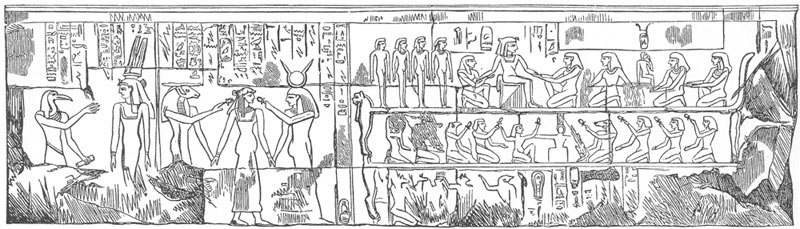
| "Horus: virgin birth, Dec 25, twelve disciples, crucifixion" | 1880s | Gerald Massey's lectures & Ancient Egypt: The Light of the World; via Alvin Boyd Kuhn to The Pagan Christ (2004) and Zeitgeist (2007). See Part IV for what the Luxor wall actually shows. |
| "Reincarnation was removed from Christianity at a council (553 AD)" | 19th–20th c. | Theosophical-era claim built on the anathemas against Origen; examined and dissolved in Part III. |
| "Sin is ignorance; nothing to forgive, only to awaken from" | 1875–1910s | Theosophy's karma-without-grace plus New Thought's "error-thought" (Mary Baker Eddy's circle and successors). |
| "I don't do labels; truth can't be organized; my path is my own" | 1929 | Jiddu Krishnamurti's dissolution of the Order of the Star — an event inside Theosophy: the World-Teacher resigning the role the Society built for him. |
Two features of this table deserve a moment of quiet attention.
The tree has a trunk. Follow any row upward and you arrive, within a step or two, at the same place: the Theosophical Society, founded New York, 1875, and the New Thought publishing world beside it. "Christ-consciousness," "ascended masters," "akashic records," the India-Jesus, the Horus-Jesus, the "New Age" itself — one lineage, one half-century, largely one city-pair (New York–Chicago) plus Adyar. Your beliefs do not converge on the world's traditions. They converge on a mailing address.
Even the anti-label instinct is on the tree. The last row is the one readers most resist, so be precise about it. The reflex "I'm not part of any movement — truth is pathless — no one can hand it to you" entered mass circulation on a specific evening in 1929, when Krishnamurti — raised from boyhood by the Theosophical Society to be its World Teacher — dissolved the order of thousands assembled to follow him, with the words at the head of this paper.[15] It was a noble act. It was also, historically, a Theosophical schism: the pathlessness doctrine is the movement's own child, born of its greatest embarrassment. When you decline all labels in those words, you are not standing outside the tradition. You are practicing its most successful splinter.
Rabbit holes · read your ancestors
- The Kybalion (1908) — read it and count how many of your "universal principles" it minted; then read about its actual authorship.
- Benner, The Impersonal Life (1914) — if "I AM = the God within" is on your list, this is where its modern voice comes from.
- Alice Bailey — coiner of the "New Age" frame; skim any summary and mark the vocabulary you recognize.
- Notovitch and the "Life of Saint Issa" — the Jesus-in-India source, and its exposure.
- A Course in Miracles — the largest single modern carrier of the Christ-consciousness re-reading.
- Hanegraaff, New Age Religion and Western Culture (1996); Hammer, Claiming Knowledge (2001) — the academic genealogies this section compresses.
Part III · Objections
The escape hatches, closed in order
At this point a series of doors present themselves, each promising exit from the genealogy. They deserve to be taken seriously and in order, because each contains something true — and each, examined, leads back into the building.
1. "I worked it out for myself."
Sometimes people do independently reconvene old ideas; the test is vocabulary. Genuinely independent convergence arrives in your own words. What actually sits in the inventory arrives in coined terms — "Christ-consciousness," "ascended masters," "akashic records," "everything is vibration," "the universe experiencing itself" — trademarks with known trademark-holders. If your private revelation speaks fluent Bailey and Atkinson, it was not private. This is no insult to your intelligence; it is how culture works. No one derives the water they swim in. But then the honest description of your position is not "I found this," it is "I absorbed this" — and absorbed things inherit the credibility of their source, which is what Part IV is for.
2. "It comes from my own experience."
The experience is not in dispute — the stillness, the dissolution of the self-boundary, the certainty of presence. People have these experiences in every century and every tradition, and this paper takes them as data. What the experience cannot do is supply its own metaphysical caption. The same unitive event is read by the Vedantin as identity with Brahman, by the Buddhist as the emptiness of self, by Teresa of Ávila as union with a God who remains Other — readings that contradict each other, which is the standard scholarly objection (Katz and after) to "all mystics find the same thing."[16] So when your experience seems to announce, specifically, that you are God, that Jesus was one master among many, that all religions secretly agree — notice that it announces the doctrines of Part II's table, in Part II's vocabulary. The event was yours. The caption was preinstalled.
3. "The parallels between the religions are just obvious."
Some parallels are real and shallow (ethics of reciprocity, ascetic technique); the deep ones on your list were manufactured, and we can often name the workshop. The Horus-Jesus set was assembled by Gerald Massey in the 1880s from a Victorian line-drawing of the Luxor temple reliefs — panels which actually depict the divine conception of Pharaoh Amenhotep III: no virgin, no star, no magi, no December, no Horus. When the full claim-set (including "Iusa," the alleged Egyptian name of Jesus) was put to twenty working Egyptologists, the response was unanimous: none of it is in the Egyptian record.[9] The wider "dying-and-rising god" category dissolved the same way under J. Z. Smith's examination.[10] The method that produced your "obvious" parallels was: translate the foreign material into Christian vocabulary, then marvel at the echo of your own translation. Once you can see the trick, you will find you cannot unsee it — and you will start catching it in every meme that reaches you.
4. "The Church suppressed the real teachings."
Two specific claims carry this whole genre, so examine both. Reincarnation deleted in 553: the Second Council of Constantinople anathematized positions associated with Origen — chiefly the pre-existence of souls, a doctrine Origen coupled with explicit arguments against transmigration. Pre-existence is not reincarnation; nothing about reincarnation was "removed from the Bible," whose text is attested in manuscripts predating the council by centuries.[17] The suppressed earlier gospels: the Gospel of Thomas — the crown witness — is dated by mainstream scholarship to the mid-second century, two to three generations after the canonical gospels, which are first-century documents by common critical consent.[18] Excluded, yes; earlier and purer, no. And where this genre's documents can be tested end to end, the results are consistent: Notovitch's Tibetan gospel of 1894 was exposed within two years — the monastery denied the visit, and the exposure was led by Max Müller, the same philologist who had just finished examining Blavatsky's Eastern claims. The suppression story reverses the actual evidence: the tradition's documents are early and public; the "suppressed" ones are late, or fabricated, or both.
5. "Science — quantum physics — is confirming it."
One dating observation settles this economically: "everything is vibration" and "the universe is mental" were published in Chicago in 1906–08, before the physics they now claim as confirmation existed. The doctrine did not follow the science; it preceded it and later annexed its vocabulary — exactly as it had previously annexed Sanskrit's, and Egypt's. As for the observer effect: measurement in quantum mechanics involves physical interaction, not consciousness, a point on which physicists across every interpretive camp agree. A belief system that successively claims the authority of Egypt, the Himalayas, and the photon — always retrospectively, always without the specialists' consent — is telling you something about its method.
6. "Even so — it works for me."
This is the honest last door, and it deserves an honest answer: practices lifted from the traditions (stillness, attention, gratitude, fasting) do work; they were engineered over millennia to work, and no one is asking you to drop them. But "works for me" cannot rescue the historical items on the inventory — Jesus's Buddhahood, the council conspiracy, the Egyptian Christ — because "works" was never their claim; true was. And note, gently, what the frame quietly deleted while it felt like it was only adding freedom: forgiveness (incoherent once sin is merely ignorance), the neighbor (a solo path has no one who can correct you), and the possibility of being wrong in a way that matters. A worldview in which nothing can be owed and no one can correct you is very comfortable. Comfort was, in fact, the product being sold. Whether it is the product you want is the one question this paper leaves entirely to you.
Part IV · The record
The pedigree, tested
Why does the genealogy matter, if the ideas might be true anyway? Because the lineage did not present itself as a set of interesting Victorian proposals. It presented itself as recovered antiquity — and antiquity was the entire warrant. "Older than all religions, therefore prior, therefore true." That claim has been formally examined four times, by four independent disciplines, across four centuries. Here is the record, in brief; the full apparatus, with primary sources scanned and linked, is in the companion paper.
1614 — philology. The lineage's deepest root, the "ancient Egyptian" books of Hermes Trismegistus, were dated by Isaac Casaubon's Greek analysis to the early centuries AD — late compositions, not primordial wisdom. Four hundred years of scholarship has refined, never reversed, the verdict. The god Thoth is ancient; the books in his name are not.[4]
1885 — investigation. The Mahatma letters — the lineage's living proof of hidden masters — were examined on site by the Society for Psychical Research after Blavatsky's own staff described how the phenomena were staged. Verdict: fraud (contested a century later on the handwriting analysis; read both reports and decide[5,6]). The "oldest book in the world," the Book of Dzyan, has never been produced by anyone; its earliest attestation remains London, 1888.
1895 — bibliography. The "secret doctrine's" dazzling erudition was traced line by line to roughly a hundred contemporary books, copied errors included — the fingerprint that distinguishes a library from a revelation.[7]
1893 & 2004 — the specialists. The era's greatest Sanskritist examined the "esoteric Buddhism" and found amateur blunders.[8] A century later, the Egyptian parallels were put to twenty Egyptologists: unanimous rejection.[9] And the traditions themselves — Buddhist, Hindu — formally disowned the movement that claimed to be their secret core, on doctrinal grounds (Buddhism's defining no-self is flatly contradicted by the Over-Soul your inventory assumes). Vivekananda's verdict on the Theosophists stands for the set: the Hindus "do not stand in need of dead ghosts of Russians and Americans."[11]
Every checked item in Part I inherits its credibility from this pedigree — and the pedigree, wherever it could be tested, failed. Not "was persecuted": failed examination — by philologists, investigators, bibliographers, and the very traditions it claimed as family. What you absorbed as timeless was, at every tested point, recent; what you absorbed as suppressed was, at every tested point, either late or manufactured. The ideas may still attract you. But they can no longer attract you as ancient wisdom, because that is the one thing the record shows they are not.
Rabbit holes · check the record yourself
- The Hodgson Report (SPR Proceedings III, 1885) and Harrison's 1986 counter-case — read both sides of the one occult claim ever examined forensically, twice.
- Coleman's source-analysis (1895) — appendix to Solovyov; the secret doctrine's actual bookshelf.
- Gasque's poll of Egyptologists (2004) — the Horus claims, put to the people who read the walls.
- Vivekananda, "Stray Remarks on Theosophy" — the tradition you were told secretly agreed, in its own words.
- Paper № 1 — the complete case with all primary sources.
Part V · The inheritance
What you actually inherited
If the paper ended here it would have taken something from you and returned nothing, which is neither the intent nor the truth of the matter. So end with the real inheritance — because underneath the manufactured pedigree there are genuine articles, older than Blavatsky by millennia, and they are not what the retail versions told you they were. They are more precise, and the precision is the interesting part.
"The kingdom of God is within you" is a real crux in Luke's Greek — entos hymōn, "within you" or "among you," a live translation question for two thousand years — and the tradition's own mystics have always read the kingdom as genuinely present and interior as well as coming. What the tradition never said is that the kingdom is merely a state of mind: the precise claim is inaugurated presence — already here, not yet complete. You were sold the blurred half of a sharp idea. The Greek is one click away; it is better than the meme.
"I AM THAT I AM" really is the verb of being — ehyeh asher ehyeh — and classical theology really did conclude that God is not a being among beings but Being itself, in whom everything that exists participates. That is Aquinas, not Bailey. The precise version differs from the retail one at exactly one seam: the awareness reading these words participates in that Being; it is not identical with it. Participation is the stronger claim, not the weaker — it means the presence you have sensed is real and is not you, which is the one possibility the inventory never allowed you to consider: that the depth you encountered might be Someone.
Divinization itself — the intuition that a human life can be filled with God — is not an esoteric secret. It is on the surface of Eastern Christianity, where it has a name (theosis), a literature seventeen centuries deep, a discipline, and a safeguard: by grace, not by nature; union, not identity. The hunger the modern movement fed is real and honorable. It was being fed, with precision instruments, all along.
And for the reader who suspects that no one who has truly gone deep into the esoteric path could say all this — one witness, briefly. Valentin Tomberg spent the 1930s as a leading figure in the Theosophical lineage's most sophisticated branch, and knew its inner workings as no critic could. He then submitted to the Church, and spent his last decade writing, anonymously, the Méditations sur les 22 arcanes majeurs du Tarot — the whole esoteric apparatus marched willingly under the authority of the tradition, Christ no longer "a master" among hidden masters but the Master, unrepeatable.[12] What he abandoned at the border was not the depth. It was the pedigree — the same pedigree this paper has been examining. The path back exists, and it was walked by one of the movement's own best minds, at the height of his powers, with his eyes open.
So the conclusion is not "believe something else." It is smaller and harder: know your genealogy. You checked boxes in Part I believing them to be discoveries; they were inheritances from a lineage younger than the lightbulb, whose claims to antiquity failed every examination they met. The feeling of uniqueness was the packaging. The questions underneath — is the kingdom near, is Being personal, can a creature be filled with God — are the true ancient inheritance, and they were never hidden, never suppressed, and never yours alone. They are waiting where they have always been: in public, in the sources, linked above. Read the ancestors. All of them. That is the whole ask.
Apparatus
References & sources
- Blavatsky, H. P. Isis Unveiled (1877); The Secret Doctrine (1888); The Key to Theosophy (1889). archive.org
- Atkinson, W. W. ["Three Initiates"]. The Kybalion. Chicago, 1908. archive.org
- Benner, Joseph [anon.]. The Impersonal Life. 1914. archive.org
- Casaubon, Isaac. De rebus sacris et ecclesiasticis exercitationes XVI. London, 1614. 1614 scan. Cf. Copenhaver, Hermetica (1992); Fowden, The Egyptian Hermes (1986).
- The Hodgson Report. SPR Proceedings III (1885). archive.org
- Harrison, Vernon. "J'Accuse" (1986/1997). online text
- Coleman, W. E. "The Sources of Madame Blavatsky's Writings," in Solovyov, A Modern Priestess of Isis (1895). archive.org
- Müller, F. Max. "Esoteric Buddhism," The Nineteenth Century (1893); Theosophy, or Psychological Religion (1893). archive.org
- Gasque, W. Ward. HNN, 2004. hnn.us
- Smith, Jonathan Z. Drudgery Divine (1990); "Dying and Rising Gods," Encyclopedia of Religion (1987). Cf. Ehrman, Did Jesus Exist? (2012).
- Vivekananda. "Stray Remarks on Theosophy." online text
- [Tomberg, Valentin.] Méditations sur les 22 arcanes majeurs du Tarot. Paris: Aubier Montaigne, 1980; Eng. trans. 1985.
- Hanegraaff, Wouter. New Age Religion and Western Culture: Esotericism in the Mirror of Secular Thought. Leiden, 1996.
- Hammer, Olav. Claiming Knowledge: Strategies of Epistemology from Theosophy to the New Age. Leiden, 2001.
- Krishnamurti, J. Dissolution speech, Ommen, 3 August 1929. Context: Order of the Star in the East.
- Katz, Steven T. "Language, Epistemology, and Mysticism," in Mysticism and Philosophical Analysis. Oxford, 1978.
- On 553: Second Council of Constantinople; Origen, De Principiis (against transmigration, with pre-existence).
- Gospel of Thomas: text, witnesses, and dating discussion at Early Christian Writings.